
Ball VS Ball
Physics Arena Duel • Roblox
Ball VS Ball Wiki: Balls, Codes & Duel Guide
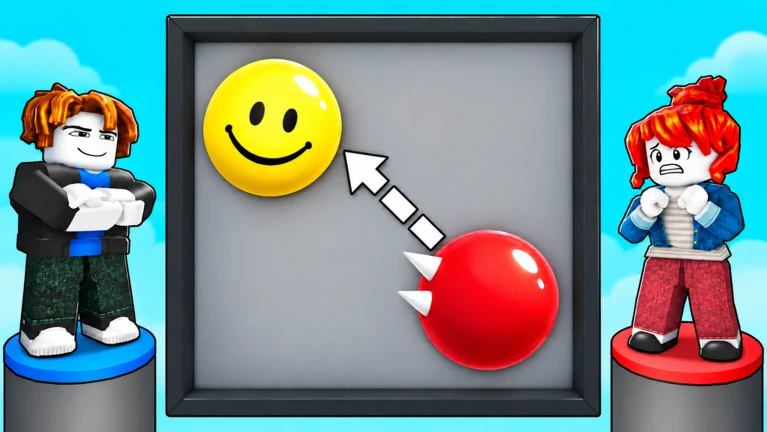
Ball VS Ball is a physics duel game where you pick a ball, lock one aim, and then watch two orbs fight it out while you can no longer touch the outcome.
Live Snapshot
| Stat | Value | Reference |
|---|---|---|
| Concurrent Players | 35,381 | Roblox games |
| Total Visits | 41.8M+ | Roblox games |
| Favorites | 78,415 | Roblox games |
| Upvotes / Downvotes | 120,563 / 16,886 (87.7% positive) | Roblox votes |
| Peak Concurrent Players | 48,325 | Roblox games |
| Average Playtime | 12.71 minutes | Roblox games |
| Created At | 2026-08-12 | Roblox games |
Lore & Trivia
Overview
Ball VS Ball is a physics duel game built on an unusual bargain: you make two decisions, then you stop playing. You choose one of three offered balls, drag a single aim line, and watch as the match resolves without you. Coins fund new balls, the codes in this wiki hand a fresh account 500 of them, and Gems are the Robux-purchased currency that pays to reroll an offer you dislike. The three-heart scoring, the crate economy, and the ball roster are what the rest of this Ball VS Ball wiki covers.
It is developed by the group ATYS 3 (owner AtysGames), launched on August 12, 2026, and had grown to more than 41.8 million visits and roughly 35,000 concurrent players by late September 2026. Balls are offered as a random trio drawn from your own collection, and the reroll that replaces a bad offer is the closest thing the game has to a mid-match decision.
This hub covers the duel format, the two-currency economy, how balls are acquired, what each ball does, and the verified codes worth claiming when you start. It also documents where the wider coverage of this game is demonstrably out of date.
Verified by RoboLibrary Editorial on September 27, 2026: Mechanics below were cross-checked against the official Roblox listing and platform interfaces, then against recorded walkthroughs of the August and September 2026 builds plus independent written coverage. Frame-level figures read from footage are labelled approximate; drop rates and per-hit damage are not published by the developer.
What the Game Actually Is
The official store description frames Ball VS Ball as an arena where balls appear randomly, players pick one, and the last ball standing wins. That wording reads like a 25-player free-for-all, and the listing does show a server capacity of 25 players. The game people actually play is narrower than that.
Recorded coverage of the live build shows a lobby lined with individual match pads, each displaying a counter such as 0/2 PLAYERS. You step onto an open pad, press the interact key, and duel one opponent. The 25-player figure describes how many people share a server, not how many fight in a match.
The practical consequence is that the game is a sequence of private duels rather than a crowded brawl. That distinction changes what advice is useful: there is no third party to avoid and no crowd to hide in, so every match is decided purely by the matchup you draw and where you point the ball.
The Three-Heart Duel
A match is scored in hearts, and the hearts belong to the players while the health bar belongs to the ball. Those are two separate layers and confusing them is the most common early mistake.
- Each player begins with three hearts.
- Each ball carries its own health pool inside the round. Draining the opposing ball to zero ends that round.
- When a ball is drained, the winning ball turns on the loser and removes one heart.
- The first player to strip all three hearts wins the match.
Because hearts are lost one at a time and a round only ends when a ball is drained, a match can extend to five rounds rather than stopping at two wins — this is a first-to-three structure, not a best-of-three. Coverage that calls it "best of three" is describing the heart count loosely rather than the actual round ceiling.
Rounds that run long are not a stalemate. Damage accumulates on both balls until one breaks, so a drawn-out round is usually two defensive kits failing to finish each other.
Coins and Gems
Ball VS Ball runs two currencies, and they do not convert into one another. Getting this straight early prevents a wasted purchase.
| Currency | How you get it | What it buys |
|---|---|---|
| Coins | Earned from playing matches, scaled to your ball's performance, and paid out even when you lose | Ball crates and shop items |
| Gems | Purchased with Robux; no gameplay route earns them | Rerolling the ball offer during a round, plus premium crates |
Written coverage of this game splits between calling the premium currency "Gems" and "Diamonds," and the official description names neither. The in-game reroll prompt is the tiebreaker, and recorded walkthroughs of the September build consistently show the reroll currency labelled Gems across several independent sessions. Some community pages still use "Diamonds," which appears to be an older or translated label for the same currency rather than a third resource.
Two consequences follow. First, Gems are strictly a convenience layer: a player who never spends Robux can still unlock balls, just without the ability to reroll an offer they dislike. Second, you can recognise third-party advice that has not verified anything, because it describes earning or redeeming free Gems. No mechanism in this game produces Gems without Robux.
Balls, Crates and the Reroll
Every round opens the same way: the game offers three balls drawn at random from the balls you own, and you either pick one or reroll the offer. The inventory you have built therefore determines the quality of every decision you get to make. A narrow collection means a narrow set of answers.
New balls come from crates rather than from crafting or levelling. The entry-level crate is opened with Coins, and recorded coverage puts it at 150 Coins per pull. Higher crate tiers and cosmetic crates exist alongside it, and premium containers are where Gems get spent.
Cosmetics are a separate track. Explosion and Flyer families change what happens visually when a ball is drained or when the winner strikes the loser, and they have no effect on the fight itself. Buying them before you have a workable set of balls is the clearest way to slow your own progress.
Two rewards are worth claiming immediately. Completing your first battle — winning is not required — grants a free ball crate, and joining the developer group and liking the game adds further free rewards as stated on the official store page. Details for the code route are on the codes page, and the full per-ball breakdown is on the balls reference.
Where Public Coverage Goes Wrong
This game accumulated a lot of confidently wrong coverage very quickly, and knowing which parts to distrust is genuinely useful.
The "no codes exist" pages are stale, not cautious. Several trackers state that Ball VS Ball has no code menu and never had one. Multiple independent publishers list five working update codes worth 100 Coins each, with an identical redemption path through the present icon. The reason for the split is timing: the code box was added with a later update, so pages last checked in early September are describing a build that no longer exists. One publisher even contradicts itself, with an older page saying no codes exist and a newer page on the same site confirming the menu.
Ability descriptions without numbers are the norm, and that is not an accident. No competitor publishes a damage value, cooldown, or threshold, because the developer publishes none either. Every explanation of what a ball does reduces to relative language — "stronger", "faster", "grows over time". Any page quoting exact damage per hit is quoting a single recorded session and presenting it as a game statistic. This wiki labels such readings as approximate and attributes them to observed footage.
Rarity tiers are asserted but never populated. You will find claims that balls are organised into Rare, Epic, and Legendary bands. No source maps an individual ball to a tier, and the official listing publishes no rarity table at all. The balls reference therefore groups balls by where they come from, which is verifiable, instead of inventing a tier assignment.
Community statistics diverge wildly. Competing pages reported anywhere from roughly 4 million to 27 million visits for the same game on the same day, against an official listing figure above 41 million. The numbers here are read from the official listing and platform interfaces, and the snapshot above is dated so you can judge its age.
FAQ
What type of Roblox game is Ball VS Ball?
It is a physics arena duel. Two players each pick a ball, lock a single aim, and then watch the orbs collide until one ball is drained. The winner strikes the loser, removing one of that player's three hearts.
Are there working Ball VS Ball codes?
Yes. Five update codes are redeemable, each crediting 100 Coins for a total of 500. They are entered through the present icon in the top-left of the screen, under the Codes tab. The full list and redemption steps are on the codes page.
What are Gems used for in Ball VS Ball?
Gems are the premium currency bought with Robux, and they pay for rerolling the three balls offered at the start of a round. Coins are the earned currency and cannot be converted into Gems.
How do you win a Ball VS Ball match?
Each player starts with three hearts. Draining the opposing ball to zero makes your ball strike its owner, costing them one heart. The first player to remove all three hearts wins, and the match can run to five rounds.
Can you control the fight after locking your aim?
No. Ball selection and the single aim lock are the only in-round inputs. Once both players commit, combat resolves on its own through the physics simulation and each ball's automatic ability. There is no dodge, block, or reactive timing input in this game.
Does Ball VS Ball have game passes?
No. The game sells one-off developer products such as ball crates, cosmetic crates, and a Starter Pack, but there are no game passes to buy.
Is Ball VS Ball free to play?
Yes. Coins are earned by playing, and Coins open the ball crates that expand your collection. Gems only accelerate the process by letting you reroll an offer you dislike.
Change Log
- 2026-09-27: Initial hub published; verified live Roblox stats; documented the Gems-versus-Diamonds naming dispute, the 25-player-server versus 1v1-duel distinction, and the stale no-codes coverage.
Discussion
Sign in to join the discussion.